Click an Image below to Enlarge
Don Ramette is a Boston-born painter whose precise, luminous abstractions made a distinctive contribution to Australian geometric art in the 1970s and beyond. His story traces a journey from the ordered streets of New England to the intense light and colour of Australia, where he developed the quietly radical language seen in our 1975 Untitled canvas.
Early life and move to Australia
Don Ramette was born in 1939 in Boston, Massachusetts, growing up in a city steeped in universities, museums and a strong modernist design culture. Exposure to architecture, urban grids and the ordered geometry of Boston’s streets would later echo in the disciplined structures of his paintings.
By the late 1960s Ramette had begun to focus seriously on painting, drawn to the clarity and flatness of post‑war abstraction. In 1970 he emigrated to Australia, settling into a scene in which hard‑edge abstraction and colour‑field painting were gaining momentum through artists such as Alun Leach‑Jones, Sydney Ball and John Peart. The move brought him into contact with a smaller but highly engaged audience for abstract painting and with the particular brightness of Australian light, both of which would shape his mature work.
Developing a geometric language in the 1970s
Throughout the 1970s Ramette refined a language based on crisp geometry, optical rhythms and subtle colour gradations. He worked on square and rectangular canvases, often rotating or cropping forms so that they read as dynamic objects floating in space rather than static, centred images.
Ramette embraced synthetic polymer and oil paints, applying them in even, unmodulated layers to emphasise the flatness of the picture plane. His paintings from this decade sit comfortably alongside the work of contemporaries like Leach‑Jones and other hard‑edge painters represented in major Australian auctions, yet they maintain a quieter, almost meditative temperament grounded in gradation rather than high‑contrast colour clashes. Colour, structure and perception
Ramette’s art is built on the tension between strict geometry and atmospheric colour. In Untitled in Blue, 1976, for example, he uses synthetic polymer paint on a vertical canvas over 150 cm high, organising the surface into broad planes of blue that dissolve from deep saturation into pale tones. The edges are sharply defined, but the stepped gradations create a sense of movement, as if the colour is breathing in and out across the rigid structure.
This concern with perception links Ramette to wider international experiments in Op Art and colour‑field abstraction. Rather than using aggressive optical tricks, however, he tends to favour incremental shifts, allowing the viewer’s eye to wander slowly over the surface, registering tiny adjustments in hue and value. The result is a contemplative experience in which geometry acts as a framework for colour to unfold.
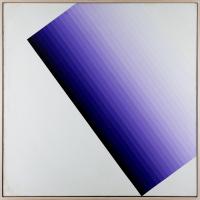
Untitled - 1975
The Untitled (1975) painting in the Art Nomad collection shows this mature language at a pivotal moment.
The composition presents a single oblique band that cuts across a white ground, its long axis running diagonally so the form appears to hover or slide through space. Within this band Ramette orchestrates a sequence of finely stepped tonal shifts, moving from the palest lilac at one end through progressively darker violets into near‑black at the opposite corner. Each step is crisply separated yet close in value to the next, so the surface reads as both a series of discrete bars and as a continuous gradient.
Seen alongside Untitled in Blue, 1976 from the National Australia Bank collection, the 1975 work can be understood as part of a concise series in which Ramette explored how a single geometric element could carry a complete optical drama. The diagonal bar in the Art Nomad collection painting functions like a shard of prismatic light: it appears to advance and recede against the neutral ground as the viewer moves, suggesting depth while remaining entirely flat.
For a collector, this painting encapsulates several key aspects of Ramette’s practice:
• The disciplined geometry typical of Australian hard‑edge abstraction in the 1970s.
• The focus on graduated colour rather than high‑contrast pattern, giving the work a meditative, almost musical rhythm.
• The international dimension of his career, with the work inscribed to New York yet closely aligned with concerns of Australian abstract painters of the period.
Placed in a contemporary interior, the painting works at two speeds: from a distance, it reads as a simple, elegant diagonal form; up close, the finely calibrated steps of violet and indigo reward slow looking, revealing the care and precision of Ramette’s brushwork.
Later recognition and legacy
While Ramette has remained a relatively discreet figure compared with some of his contemporaries, his work continues to circulate in auctions and specialist galleries dedicated to Australian abstraction, confirming an ongoing interest among collectors.
Galleries that focus on geometric and colour‑field art have presented his paintings alongside those of major Australian hard‑edge artists, emphasising the disciplined construction and subtle optical effects that characterise his canvases. As appreciation for 1970s abstraction deepens among a new generation of collectors, Ramette’s carefully structured works increase recognition of important contributions to the period’s exploration of colour, space and perception.
The Untitled 1975 painting currently with Art Nomad sits squarely within this story, offering viewers and collectors a concise, beautifully resolved example of Ramette’s approach at its most refined.
Copyright © 2008 Art Nomad. All rights reserved. Click here to view copyright statement