Click an Image below to Enlarge
Robert Owen (1937): A Life in Light, Colour and Construction
Robert Owen was one of Australia’s most intellectually adventurous and visually distinctive artists, whose career spanned more than six decades and embraced painting, sculpture, installation, photography and public art. Though sometimes associated with minimalism and constructivism, Owen’s practice was driven by a deeply personal fascination with the physics of light, the psychology of colour, and the hidden structures of mathematics and music. His work invites viewers not just to look, but to feel and think—to experience colour as emotion, geometry as rhythm, and space as a living field of possibility.
Early Life and Formative Years
Born 1937 in NSW, now living and working in Melbourne VIC. Owen showed an early aptitude for making things—drawing, painting and constructing objects from a young age. He studied sculpture at the National Art School in Sydney under Lyndon Dadswell, graduating in 1962 with a rigorous grounding in form and material.
In 1963, Owen left Australia for Europe, living first on the Greek island of Hydra for three years, then in London for nearly a decade. It was on Hydra, during a solar eclipse, that he experienced a revelation: the atmosphere acted like a prism, breaking sunlight into spectral bands of colour. This moment became a lifelong touchstone. As Owen later recalled, “What I came to England with was the ‘eclipse of the sun’ effects from Hydra… It made me look at light and refraction… and a whole series of works came from that.”
During his time in London, Owen engaged with the English constructivists and absorbed ideas from science, mathematics and music. He returned to Australia in 1975 as a mature artist, ready to reinvent himself in his homeland through ambitious installations, geometric colour paintings and abstract linear sculptures.
Artistic Practice and Themes
Owen’s work is characterised by a vibrant, recurring palette drawn from the full colour spectrum, often arranged in grids, reliefs or layered constructions. His interest in colour was not merely aesthetic but synaesthetic—he believed, like Kandinsky, that colour could stimulate one sense while involuntarily affecting another, creating a multisensory experience.
Mathematics and geometry provided another structural backbone. His grid paintings, for instance, were inspired by coloured origami papers he bought in Singapore; working with a PhD student in the 1990s, he calculated over 1.5 million possible variations. His sculptures often drew on Euclidean geometry and higher-dimensional forms—his 2011 commission for National Australia Bank, Shadow Play – Fourth Constellation, is based on the hypercube, a four-dimensional figure.
Owen also explored the intersection of art and technology, experimenting with computer graphics and construction art. He lectured in sculpture, drawing and painting at tertiary institutions, and undertook major public commissions, including works for the Sydney 2000 Olympics and the New Commonwealth Law Courts in Melbourne.
KINETIC RELIEF No. 22 (1972): A Window into Owen’s Vision
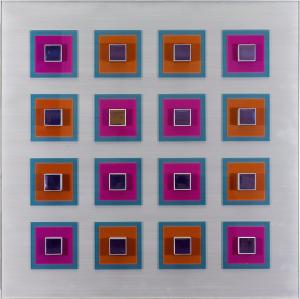
The work currently available at Art Nomad— “KINETIC RELIEF No. 22 (1972) belongs to Owen’s London period, when he was developing his engagement with geometric construction, light, colour and spatial relationships. Though titled “kinetic,” the work does not rely on mechanical movement; instead, it creates a sense of visual vibration and spatial depth through the careful arrangement of coloured planes and geometric forms.
In this relief, Owen employs a limited but vivid palette, arranged in overlapping or interlocking squares/ cubes that seem to shift as the viewer moves. The effect is both optical and psychological: the eye is drawn into a dance of contrasts, while the mind registers the underlying mathematical order. This duality—between emotion and calculation, between sensation and structure—is central to Owen’s practice.
KINETIC RELIEF No. 22 also reflects Owen’s interest in the “text of light”—the idea that colour and form can encode meaning, much like language or music. Viewers are invited not just to observe, but to decode: to feel the warmth of magenta & orange against the coolness of blue, to sense the tension between horizontal and vertical lines, and to experience the work as a living field of energy.
Major Exhibitions and Recognition
Owen’s career is marked by numerous solo and group exhibitions, both in Australia and internationally. He represented Australia at the 38th Venice Biennale in 1978, a significant honour that placed him among the country’s leading contemporary artists.
Survey exhibitions of his work include:
• Robert Owen: A Survey, Monash University Museum of Art, 1999
• Robert Owen, Art Gallery of New South Wales, 2004
• Blue Over Time: Robert Owen — A Survey, Heide Museum of Modern Art, 2021
Other notable exhibitions include:
• Fallen Light, ARC ONE Gallery, Melbourne, 2012
• Photographic Abstractions, Monash Gallery of Art, Melbourne, 2012
• The New MCA Unveiled, Museum of Contemporary Art, Sydney, 2012
He received the Australia Council Visual Arts/Crafts Emeritus Award for lifelong service to the visual arts in 2003.
Collections
His paintings, sculptures and installations are held in major public and private collections across Australia and beyond.
Selected Public and Private Collections:
• National Gallery of Australia, Canberra
• Art Gallery of New South Wales, Sydney
• National Gallery of Victoria, Melbourne
• Monash University Museum of Art, Melbourne
• Monash Gallery of Art, Melbourne
• Museum of Contemporary Art, Sydney
• Heide Museum of Modern Art, Melbourne
• State galleries in Queensland, South Australia, Western Australia and Tasmania
• New Commonwealth Law Courts, Melbourne (public commission)
• Sydney 2000 Olympics (public commission)
• Nippon Exhibition Centre, Chiba, Japan (public sculpture)
• Numerous private collections in Australia, Europe and the United States.
Robert Owen’s work remains a testament to the power of abstraction to convey deep human experience—through colour, form and the invisible structures that bind them. For collectors and viewers alike, his art offers not just beauty, but a portal into the interconnected senses of sight, sound and feeling.
Copyright © 2008 Art Nomad. All rights reserved. Click here to view copyright statement